Sensitivity Calculations
Overview
Section titled “Overview”Sensitivity calculations determine the minimum detectable flux for a gamma-ray observatory under specific observing conditions. In sensipy, sensitivity curves are used to evaluate whether a time-varying source can be detected and how long it would take to reach a specified significance level.
What is a Sensitivity Curve?
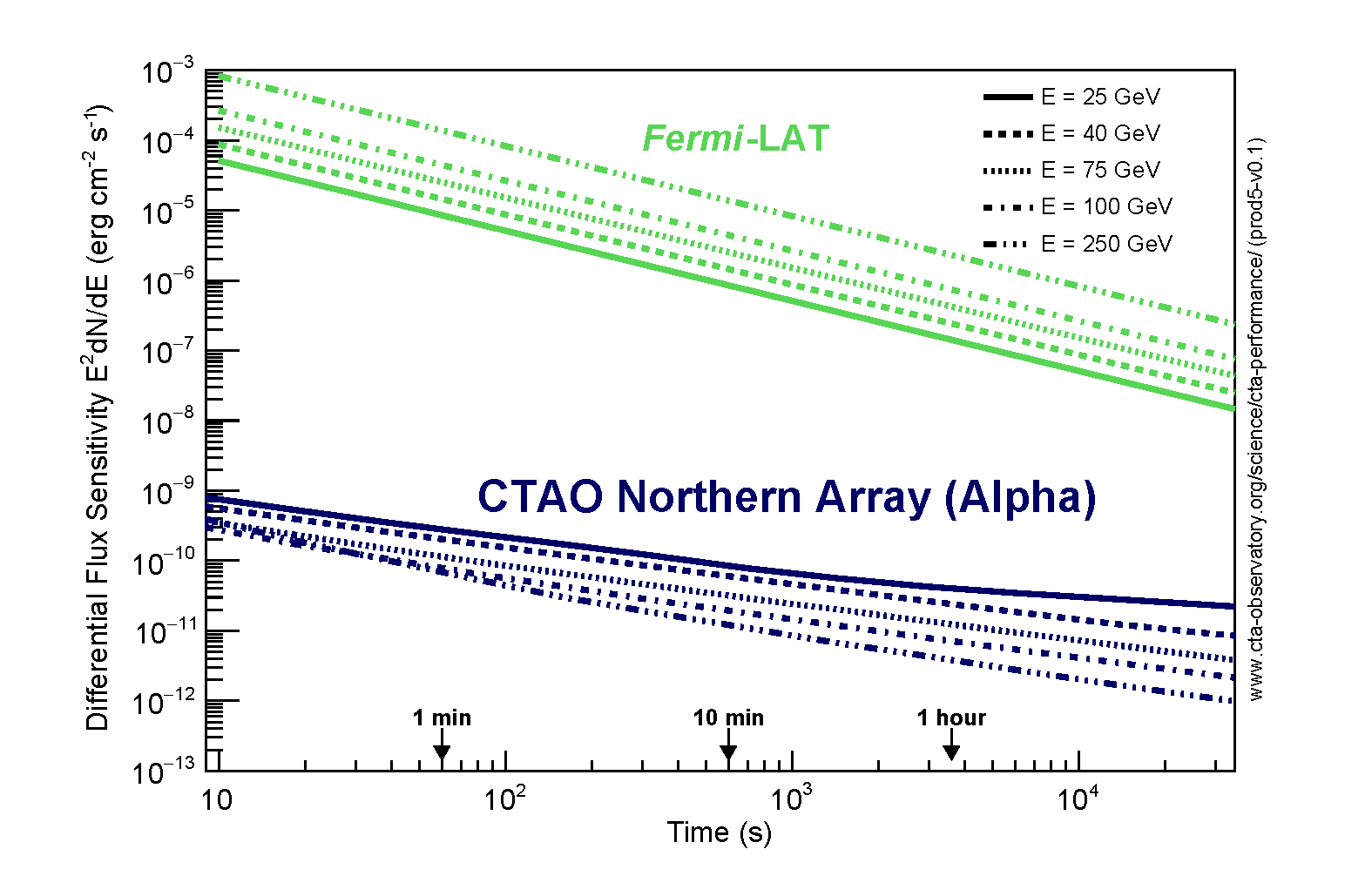
Section titled “What is a Sensitivity Curve?”A sensitivity curve represents the minimum differential flux (energy flux per unit energy) that an observatory can detect at a given significance level, as a function of observation time.
For example, see the following sensitivity curve from the CTAO Performance report on their website pertaining to the detection of a Crab Nebula-like source:
For each observation time, the sensitivity curve may either be:
- Differential flux sensitivity: E² dN/dE [GeV cm⁻² s⁻¹]
- Integral: Minimum detectable spectral flux [GeV cm⁻² s⁻¹] or photon flux [cm⁻² s⁻¹]
These curves depend on:
- Instrument Response Functions (IRFs): Define telescope performance
- Observing conditions: Zenith angle, azimuth, site (North/South)
- Energy range: Energy window of interest
- Source spectrum: The assumed spectral shape
- Region of interest: Spatial extraction region size
Creating a Sensitivity Calculator
Section titled “Creating a Sensitivity Calculator”sensipy provides the Sensitivity class for calculating sensitivity curves using Gammapy:
from sensipy.ctaoirf import IRFHousefrom sensipy.sensitivity import Sensitivityimport astropy.units as u
# Load IRFshouse = IRFHouse(base_directory="./IRFs/CTAO")irf = house.get_irf(    site="south",    configuration="alpha",    zenith=20,    duration=1800,  # seconds    azimuth="average",    version="prod5-v0.1",)
# Create sensitivity calculatorsensitivity = Sensitivity(    irf=irf,    observatory=f"ctao_{irf.site.name}",  # "ctao_south"    min_energy=20 * u.GeV,    max_energy=10 * u.TeV,    radius=3.0 * u.deg,  # Region of interest radius)
Key Parameters
Section titled “Key Parameters”| Parameter | Description | Typical Value |
|---|---|---|
irf | Instrument response function | From IRFHouse |
observatory | Observatory name | "ctao_south" or "ctao_north" |
min_energy | Minimum energy | 20 GeV or 0.02 TeV |
max_energy | Maximum energy | 10 TeV |
radius | Extraction region radius | 3.0 deg (for point sources) |
n_sensitivity_points | Number of time points | 16 (default) |
Computing Sensitivity for a Source
Section titled “Computing Sensitivity for a Source”Once you have a Source object with a time-resolved spectrum, you can compute the sensitivity curve:
from sensipy.ctaoirf import IRFHousefrom sensipy.source import Sourcefrom sensipy.sensitivity import Sensitivityfrom sensipy.util import get_data_pathimport astropy.units as u
# Load IRFshouse = IRFHouse(base_directory="./IRFs/CTAO")irf = house.get_irf(    site="south",    configuration="alpha",    zenith=20,    duration=1800,    azimuth="average",    version="prod5-v0.1",)
# Load sourcemock_data_path = get_data_path("mock_data/GRB_42_mock.csv")source = Source(    filepath=str(mock_data_path),    min_energy=20 * u.GeV,    max_energy=10 * u.TeV,    ebl="franceschini")
# Create sensitivity calculatorsens = Sensitivity(    irf=irf,    observatory="ctao_south",    min_energy=20 * u.GeV,    max_energy=10 * u.TeV,    radius=3.0 * u.deg,)
# Compute sensitivity curve for this sourcesens.get_sensitivity_curve(source=source)
# Access the sensitivity curveprint(sens.sensitivity_curve)print(sens.photon_flux_curve)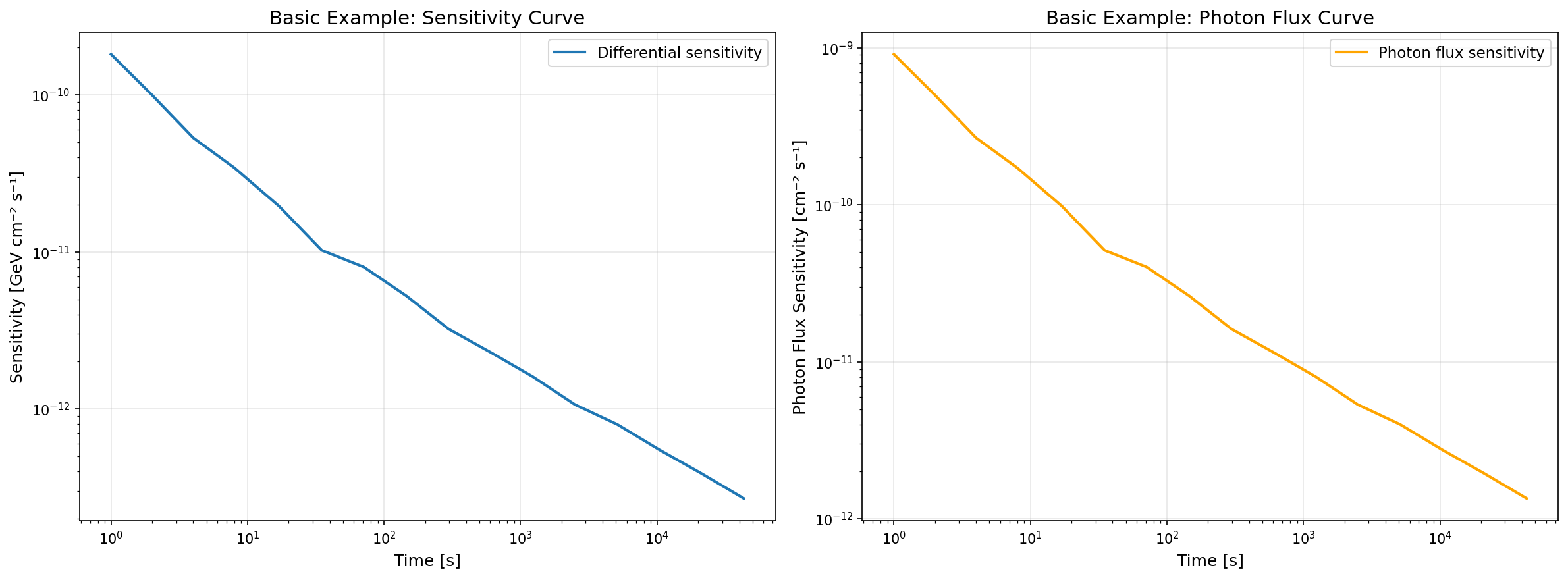
from sensipy.ctaoirf import IRFHousefrom sensipy.source import Sourcefrom sensipy.sensitivity import Sensitivityfrom sensipy.util import get_data_pathimport astropy.units as u
# Load IRFshouse = IRFHouse(base_directory="./IRFs/CTAO")irf = house.get_irf(    site="south",    configuration="alpha",    zenith=20,    duration=1800,    azimuth="average",    version="prod5-v0.1",)
# Load sourcemock_data_path = get_data_path("mock_data/GRB_42_mock.csv")source = Source(    filepath=str(mock_data_path),    min_energy=20 * u.GeV,    max_energy=10 * u.TeV,    ebl="franceschini")
# Specify custom time rangesens = Sensitivity(    irf=irf,    observatory="ctao_south",    min_energy=20 * u.GeV,    max_energy=10 * u.TeV,    radius=3.0 * u.deg,    min_time=10 * u.s,       # Start at 10 seconds    max_time=36000 * u.s,    # Up to 10 hours    n_sensitivity_points=20,  # 20 time points)
sens.get_sensitivity_curve(source=source)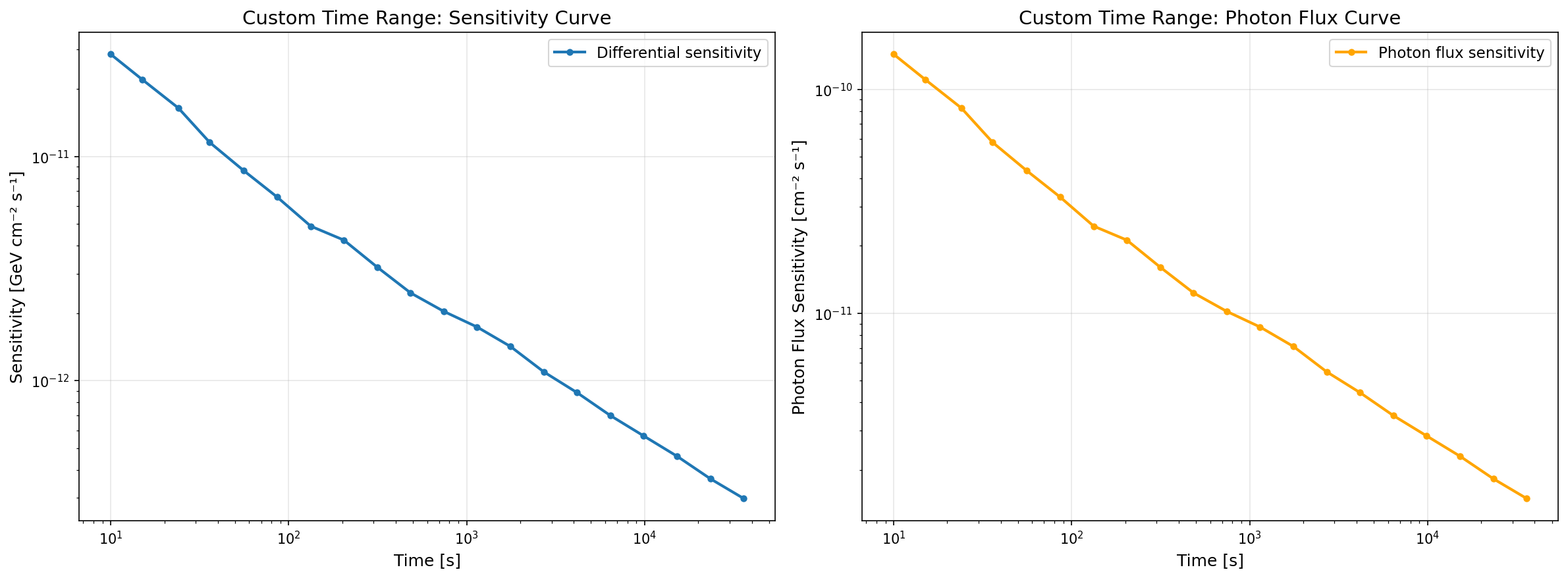
from sensipy.ctaoirf import IRFHousefrom sensipy.sensitivity import Sensitivityimport astropy.units as uimport numpy as np
# Load IRFshouse = IRFHouse(base_directory="./IRFs/CTAO")irf = house.get_irf(    site="south",    configuration="alpha",    zenith=20,    duration=1800,    azimuth="average",    version="prod5-v0.1",)
# Use pre-computed sensitivity values# Note: n_sensitivity_points must match the length of the curvessens_values = np.array([    1.74e-10, 1.10e-10, 5.81e-11, 3.41e-11, 1.87e-11,    1.12e-11, 7.64e-12, 4.51e-12, 2.95e-12, 2.14e-12,    1.50e-12, 1.16e-12, 7.62e-13, 5.61e-13, 3.96e-13,    2.71e-13, 1.85e-13, 1.27e-13, 8.70e-14, 5.95e-14]) * u.Unit("erg / (cm2 s)")photon_flux_values = np.array([    8.72e-10, 5.52e-10, 2.91e-10, 1.71e-10, 9.36e-11,    5.63e-11, 3.83e-11, 2.26e-11, 1.48e-11, 1.07e-11,    7.52e-12, 5.83e-12, 3.82e-12, 2.81e-12, 1.98e-12,    1.36e-12, 9.27e-13, 6.35e-13, 4.35e-13, 2.98e-13]) * u.Unit("1 / (cm2 s)")
sens = Sensitivity(    observatory="ctao_south",    radius=3.0 * u.deg,    min_energy=20 * u.GeV,    max_energy=10 * u.TeV,    min_time=10 * u.s,        # Match the time range of your pre-computed curves    max_time=10000 * u.s,     # 10s to 10,000s    n_sensitivity_points=20,   # Must match the length of your curves    sensitivity_curve=sens_values,    photon_flux_curve=photon_flux_values,)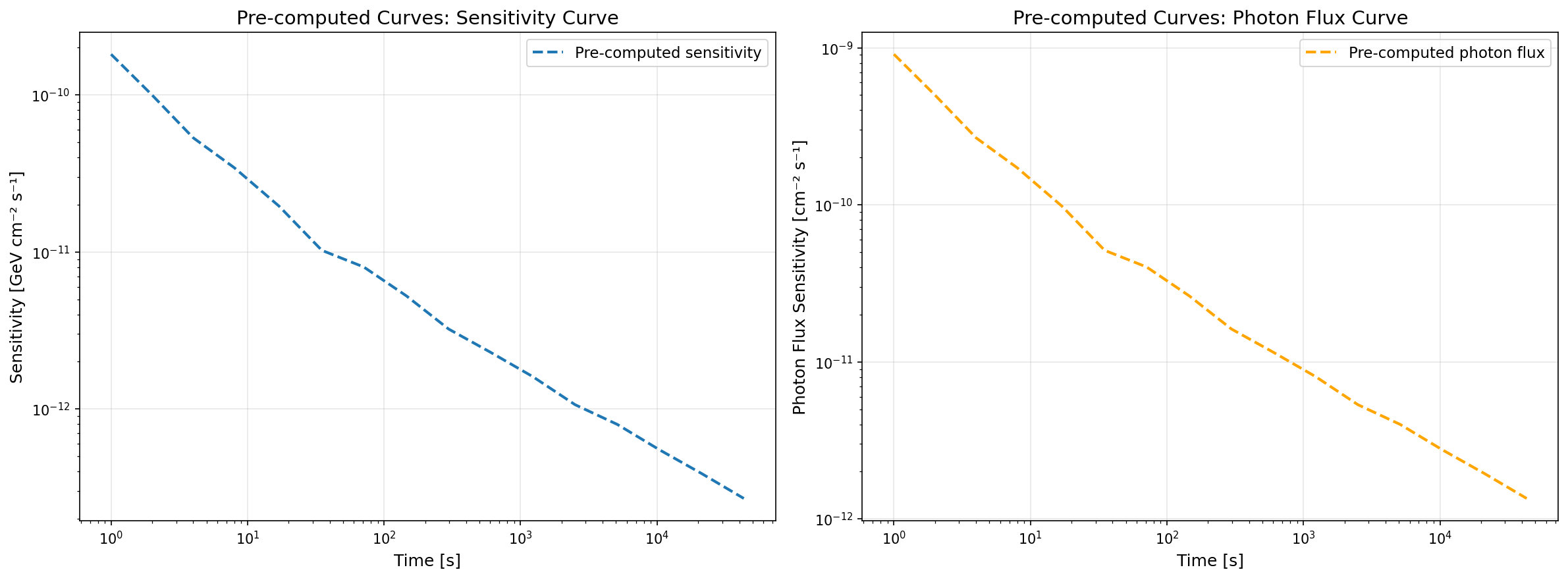
Querying Sensitivity Values
Section titled “Querying Sensitivity Values”After computing the sensitivity curve, you can query sensitivity at arbitrary times:
from sensipy.ctaoirf import IRFHousefrom sensipy.source import Sourcefrom sensipy.sensitivity import Sensitivityfrom sensipy.util import get_data_pathimport astropy.units as u
# Load IRFshouse = IRFHouse(base_directory="./IRFs/CTAO")irf = house.get_irf(    site="south",    configuration="alpha",    zenith=20,    duration=1800,    azimuth="average",    version="prod5-v0.1",)
# Load sourcemock_data_path = get_data_path("mock_data/GRB_42_mock.csv")source = Source(    filepath=str(mock_data_path),    min_energy=20 * u.GeV,    max_energy=10 * u.TeV,    ebl="franceschini")
# Create sensitivity calculator and compute curvesens = Sensitivity(    irf=irf,    observatory="ctao_south",    min_energy=20 * u.GeV,    max_energy=10 * u.TeV,    radius=3.0 * u.deg,)sens.get_sensitivity_curve(source=source)
# Get sensitivity at a specific timetime = 1000 * u.sdiff_sens = sens.get(time, mode="sensitivity")phot_flux = sens.get(time, mode="photon_flux")
print(f"At t={time}:")print(f"  Differential sensitivity: {diff_sens}")print(f"  Photon flux sensitivity: {phot_flux}")
Sensitivity Modes
Section titled “Sensitivity Modes”sensipy supports two sensitivity modes:
1. Differential Sensitivity
Section titled “1. Differential Sensitivity”The minimum detectable energy flux per unit energy (dN/dE):
# Differential sensitivity in erg cm⁻² s⁻¹diff_sens = sens.get(time, mode="sensitivity")Unit: erg cm⁻² s⁻¹ or TeV cm⁻² s⁻¹
2. Photon Flux Sensitivity
Section titled “2. Photon Flux Sensitivity”The minimum detectable photon flux (integrated over energy):
# Photon flux sensitivity in cm⁻² s⁻¹phot_flux = sens.get(time, mode="photon_flux")Unit: cm⁻² s⁻¹
Direct Sensitivity Calculation: Integral vs Differential
Section titled “Direct Sensitivity Calculation: Integral vs Differential”sensipy provides get_sensitivity_from_model() for directly calculating sensitivity at a specific time using a spectral model. This method supports two types of sensitivity calculations:
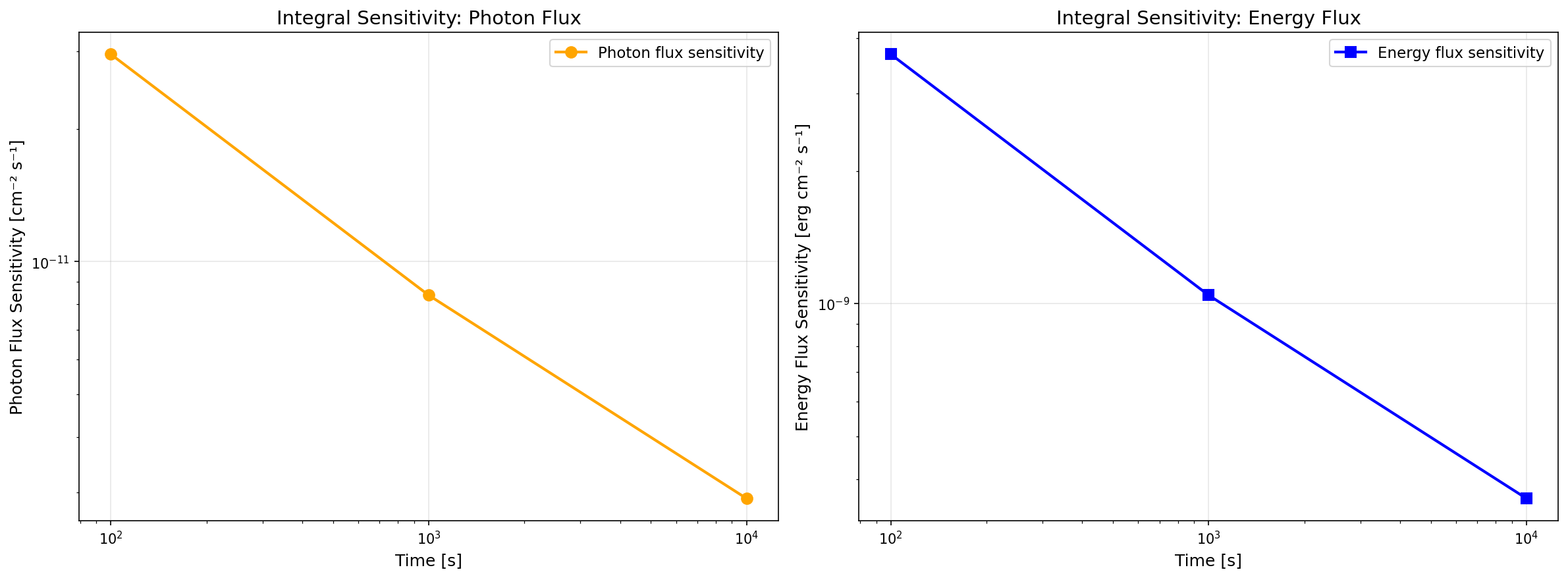
Integral Sensitivity
Section titled “Integral Sensitivity”Integral sensitivity calculates the minimum detectable flux integrated over the entire energy range. It returns a single value representing the total photon flux or energy flux needed for detection.
Key characteristics:
- Returns a single sensitivity value for the entire energy range
- Units: Photon flux [cm⁻² s⁻¹] or Energy flux [erg cm⁻² s⁻¹]
- Uses Monte Carlo simulations with iterative root finding
- More computationally intensive but accounts for full spectral shape
from sensipy.ctaoirf import IRFHousefrom sensipy.sensitivity import Sensitivityfrom gammapy.modeling.models import PowerLawSpectralModelimport astropy.units as u
# Load IRFshouse = IRFHouse(base_directory="./IRFs/CTAO")irf = house.get_irf(    site="south",    configuration="alpha",    zenith=20,    duration=1800,    azimuth="average",    version="prod5-v0.1",)
# Create a sensitivity calculatorsens = Sensitivity(    irf=irf,    observatory="ctao_south",    min_energy=20 * u.GeV,    max_energy=10 * u.TeV,    radius=3.0 * u.deg,)
# Define a spectral model (e.g., power law)spectral_model = PowerLawSpectralModel(    index=2.0,    amplitude=1e-12 * u.Unit("cm-2 s-1 TeV-1"),    reference=1 * u.TeV,)
# Calculate integral sensitivity at a specific timetime = 1000 * u.sresult = sens.get_sensitivity_from_model(    t=time,    spectral_model=spectral_model,    sensitivity_type="integral",    redshift=0.0,  # Set to > 0 for extragalactic sources)
print(f"Photon flux sensitivity: {result['photon_flux']}")print(f"Energy flux sensitivity: {result['energy_flux']}")
Examples for a power law spectral model with index 2.0 at three different timesteps:
Differential Sensitivity
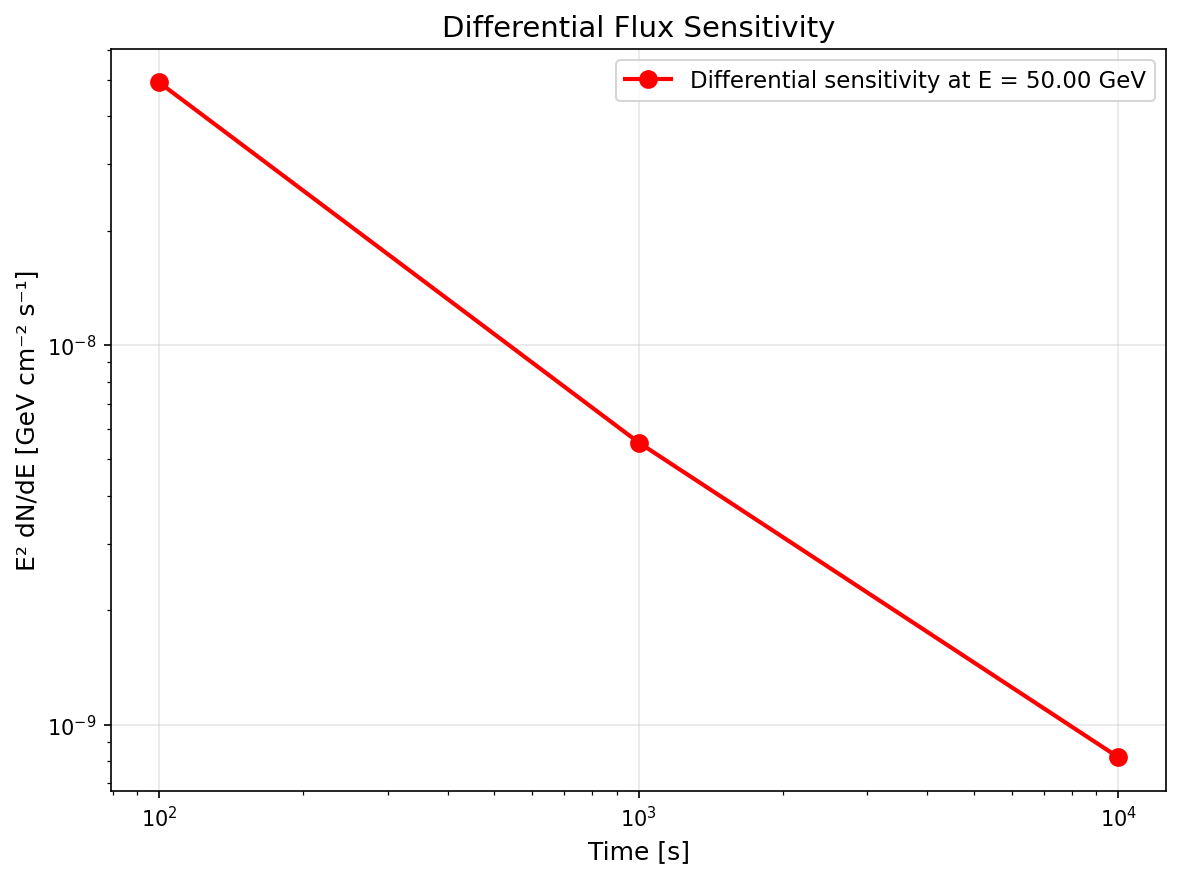
Section titled “Differential Sensitivity”Differential sensitivity calculates the minimum detectable flux per unit energy at each energy bin. It returns a table with sensitivity values as a function of energy.
Key characteristics:
- Returns sensitivity values for each energy bin
- Units: dN/dE [GeV⁻¹ cm⁻² s⁻¹] at each energy
- Uses analytical background estimation
- Faster computation, provides energy-dependent sensitivity
from sensipy.ctaoirf import IRFHousefrom sensipy.sensitivity import Sensitivityfrom gammapy.modeling.models import PowerLawSpectralModelimport astropy.units as u
# Load IRFshouse = IRFHouse(base_directory="./IRFs/CTAO")irf = house.get_irf(    site="south",    configuration="alpha",    zenith=20,    duration=1800,    azimuth="average",    version="prod5-v0.1",)
# Create a sensitivity calculatorsens = Sensitivity(    irf=irf,    observatory="ctao_south",    min_energy=20 * u.GeV,    max_energy=10 * u.TeV,    radius=3.0 * u.deg,)
# Define a spectral modelspectral_model = PowerLawSpectralModel(    index=2.0,    amplitude=1e-12 * u.Unit("cm-2 s-1 TeV-1"),    reference=1 * u.TeV,)
# Calculate differential sensitivity at a specific timetime = 1000 * u.sresult_table = sens.get_sensitivity_from_model(    t=time,    spectral_model=spectral_model,    sensitivity_type="differential",    redshift=0.0,)
# The result is a Table with columns: energy, e_min, e_max, sensitivityprint(result_table)
Example for a power law spectral model with index 2.0 at three different timesteps:
When to Use Each Type
Section titled “When to Use Each Type”Use Integral Sensitivity when:
- You need a single sensitivity value for the entire energy range
- Comparing total flux requirements across different sources
- Working with sources where the full spectral shape matters
- You have computational resources for more accurate calculations
Use Differential Sensitivity when:
- You need energy-dependent sensitivity information
- Analyzing which energy ranges contribute most to detection
- Comparing sensitivity across different energy bands
- You need faster computation times
Sensitivity and Source Spectra
Section titled “Sensitivity and Source Spectra”The sensitivity calculation uses the source spectral shape to optimize energy binning and background estimation. This is why you pass a Source object (with get_sensitivity_curve(source=source)).
Spectral Template Scaling
Section titled “Spectral Template Scaling”Internally, sensipy uses a ScaledTemplateModel to adjust the source normalization while preserving its spectral shape. This allows the code to find the minimum flux level that achieves the target significance.
from sensipy.sensitivity import ScaledTemplateModelfrom gammapy.modeling.models import TemplateSpectralModelimport astropy.units as uimport numpy as np
# Create a template spectral model with energy and flux valuesenergy = np.logspace(-1, 2, 10) * u.TeV  # 0.1 to 100 TeVvalues = np.ones(10) * u.Unit("1 / (TeV s cm2)")  # Constant flux
template_model = TemplateSpectralModel(energy=energy, values=values)
# Create a scaled template from the Gammapy modelscaled_model = ScaledTemplateModel.from_template(    model=template_model,    scaling_factor=1e-6  # Scale down initial normalization)
# The scaling factor can be adjustedscaled_model.scaling_factor = 0.5  # Reduce flux by 50%